Juvenile Fiction (Ages 8 -12), Juvenile Literature (Ages 8-12), Reviews, Teen Fiction, Teen Literature

Review: The Phantom Tollbooth by Norton Juster

Title: Juster, Norton. The Phantom Tollbooth. Random House. 1961. Tr. $17.01. 255 pages. ISBN 978-0-394-81500-8
Genre: Fiction/Science Fiction/Adventure/Fantasy
Reading Level/Interest Level: 6.7/ Grades 5-8
Awards:
Series:
Similar Titles: Alice in Wonderland by Lewis Carroll, Yellow Submarine [Motion Picture] by The Beatles
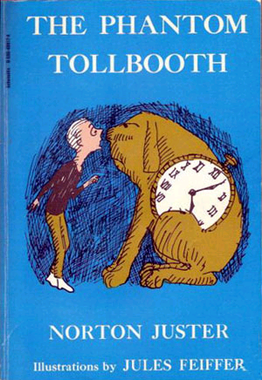
Like most children his age nowadays, young Milo is bored. Constantly bored, constantly suffering, constantly disinterested with the world and watching the clock tick by slowly, until the day he receives a map and a magic tollbooth from a mysterious benefactor. The tollbooth transports him to “The Lands Beyond”, the land named Wisdom, where he must save Princess Rhyme and Princess Reason and restore the kingdom, saving it from discord and disharmony, phrases uttered often in the book, all over the controversial topic of which is better, letters or numbers. That is, of course, if he can escape dungeons, evil mathematicians, The Doldrums, The Mountains of Ignorance and the Senses Taker, with the help of a watch bellied dog and a downer of a companion, Humbug.
With turns of phrase, vocabulary words that will stretch the imagination, visual imagery that is literally comprised of the words on the page, and settings that seem to already exist in our minds, though we failed to name them, Juster’s Phantom Tollbooth is not only a fantastic adventure of a novel, but a book that shows a new inside joke every thirty seconds that children, and especially adults, that can appreciate the irony of names and places, like the “Senses Taker” and the infuriating “Spelling Bee”  will smirk and chuckle all the way through.
It is no small wonder that this book is often compared to Through the Looking Glass or Alice in Wonderland, as it has the same non-sensical, abstract, lunacy element that Carroll’s work does, with an intellectual element that, I think, surpasses even Carroll, who focused more on morals than smarts. It seems to me that Juster writes his novel from the perspective of a parent watching his own child struggle with the common “boredom” phase just as he did, and is giving him the tools to not only tell his own story out of nothing, but is teaching him how to look at his world in such a way, that it will always be interesting, even when there is nothing of interest to be had.

While I read this book at the age of 11 and understood it, I believe, due to the non-sequential delivery of events and the significant and advanced vocabulary, I would have enjoyed it much more at 13, even though we read it as a group. It is my recommendation that older tweens and advanced readers read this book as soon as they feel comfortable, and aren’t afraid to carry a dictionary near them while reading.

Recommended Ages: 12 & Up, Teen
Juvenile Fiction (Ages 8 -12), Juvenile Literature (Ages 8-12), Reviews

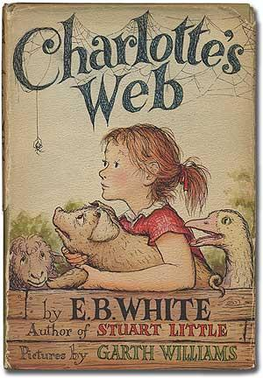
Review: Charlotte’s Web by E.B. White

Title: White, E.B. Charlotte’s Web. Harper Collins. 1950. Tr.$18.89. 184 pages. ISBN 978-0-06-026386-7
Genre: Fiction
Reading Level/Interest Level: 4.4/ Grades 3-6
Awards: Newbery Honor 1953
Series: None
Similar Titles: James and the Giant Peach by Roald Dahl, Stuart Little by E.B. White

In a strange twist of fate, a young girl named Fern, saves a runt pig, whom she names Wilbur, from certain death. Raising him as a loving pet,  she soon learns that she must relocate Wilbur to her Uncle Zuckerman’s farm, where, despite Fern’s frequent visits, Wilbur finds himself in a daily battle to survive and keep himself from the chopping block and the Zuckerman’s Christmas dinner table.


With a whole host of talking barn animals, such as geese, horses, sheep and a surly rat named Templeton, Wilbur learns the hard facts of life and eventually befriends another outcast, a precocious spider named Charlotte, who is determined to save Wilbur’s life.  In an incredulous stroke of genius, Charlotte begins to spin short words and phrases into her web, to remind the Zuckerman’s, and the town, that this pig has value,  that he’s “terrific” and “humble”, and simply put,  “some pig,”  pig enough to go to the county fair.


This classic tale shows the unselfish, lifelong nature of true friendship and generous living as Wilbur shows his eternal gratitude for Charlotte long after she is gone, passing along her values and wisdom to the next generation and proving that once you have a friend, you are never alone.


There is a reason why E.B. White is considered one of the quintessential children’s writers of all time. His characters are realistic, yet fantastic, full and complex. Some are warm, some are hideous, all of them have faults but are redeemable. He never gives up on man (or animal) kind, showing them a crossroads and allowing the reader to sit in suspense to see if they will do the right thing, which in term makes them question their own motivesand behaviors.
Charlotte’s Web is an indelible part of every child’s life who reads it. A heartwarming tale such as this  should be savored and always, ALWAYS passed along. As a matter of fact, I passed on my older sister’s (and subsequently my) volume onto my daughter, who will learn to love Fern, Wilbur and Charlotte as much as I do.
Recommended Ages: 8 – 12
Juvenile Fiction (Ages 8 -12), Juvenile Literature (Ages 8-12), Reviews

Review: The Lion the Witch and the Wardrobe by C.S. Lewis


Title: Lewis, C.S. The Lion, the Witch and the Wardrobe. Harper Collins. 1950. Tr. $15.34. 189 pages. ISBN 978-0-06-023481-2

Genre: Fantasy/Christian Literature
Reading Level/Interest Level: 5.5/ Grades 5-8
Awards: None
Series: Chronicles of Narnia

·         The Horse and His Boy

·         The Lion, the Witch, and the Wardrobe
·         The Magician’s Nephew
·         The Silver Chair
·         The Voyage of the Dawn Treader

Similar Titles: Gulliver’s Travels by Jonathan Swift, Wrinkle in Time by Madeline L’Engle,  His Dark Materials by Phipl Pullman.


In war ravaged England, siblings Peter, Susan, Edmund and Lucy find themselves hidden away on a country estate off a reclusive gentleman, for safe keeping. During one of their long and dreary days, Lucy finds that the ornately carved wardrobe in the home not only stores old furs, but the doorway to a hidden world as well. Upon initially finding herself in a snowy glen, talking to a faun, otherwise known as the satyr, Mr. Tumnus, Lucy comes to know of the tyrannical and cruel ruler, The White Witch, whose castle holds great evil. She has cast a spell of eternal winter upon Narnia, the land she now finds herself in, and terrorizes the land and its creatures, all of whom talk and walk as humans do. One shining hope remains, as a revolution grows surrounding a prophecy of the return of the mighty lion ruler, Aslan, and the coming of the daughters of Eve and the sons of Adam.

Returning with her brothers and sister, Lucy attempts to acclimate them to the Narnian plight. Unfortunately, Edmund, disenchanted and bitter, forges a terrible alliance, which puts him and all of Narnia in danger. Can Lucy, Peter and Susan journey to the White Witch’s castle to save Edmund and return alive? Will they take up arms and defend Narnia, bringing peace back to the castle at Cair Paravel, and heralding the return of the mighty Aslan? Will they leave their own world, forever?

In a tale that is heavy with Christian sentiment, and characters based off of scripture (Jesus as the lion, the light of man), the eternal battle of good and evil is enough to carry even the greatest theologian nay-sayer to the next novel. With brilliantly written scenes, mythological creatures and deep characters that represent the struggles of every child in finding their own path, and their own sense of wrong and right, Lewis creates a rich tapestry of imagination, fantasy and hope for generations to come.  While this novel was the beginning point of the series when I read them as a child, the order has been shifted to begin with  A Horse and His Boy. However, readers will still be able to start with either novel and get the full experience as it was intended, as puzzle pieces to larger picture.

Also a major motion picture.


Recommended Ages: 8 -12

Juvenile Fiction (Ages 8 -12), Juvenile Literature (Ages 8-12), Reviews

Review: Mrs. Piggle-Wiggle by Betty MacDonald

Title: Macdonald, Betty. Mrs. Piggle Wiggle. HarperTrophy. 1985. 118 pages. Pb. $3.89. ISBN 978-0-06-440148-7
Genre: Fiction
Reading Level/Interest Level: 4.5/ Grades 3-6
Awards: None
Series:

·         Book 1: Hello, Mrs. Piggle-Wiggle
·         Book 2: Mrs. Piggle-Wiggle
·         Book3: Mrs. Piggle-Wiggle’s Farm
·         Book 4: Mrs. Piggle-Wiggle’s Magic
·         Book 5: Happy Birthday Mrs. Piggle-Wiggle

Similar Titles: Lady Lollipop by Dick King-Smith, Nurse Matilda: The Collected Tales by Christianna Brand (Major Motion Picture Nanny McPhee based on Nurse Matilda), Sideways Stories from Wayside School by Louis Sachar, James and the Giant Peach by Roald Dahl


Mrs. Piggle-Wiggle is a delightfully eccentric widow who lives in an upside down house. Kids love her, initially thinking that they get away with anything they wish and experience the freedom that no other adult will give. Little do the know that Mrs. Piggle-Wiggle has a cure  for every ill, and that many of their parents will enlist her box of tricks to cure their bad behaviors.


From back-talking, to refusing to bathe or sleep, interrupting, not washing the dishes or putting away your toys, Mrs. Piggle-Wiggle will give you a dose of your own medicine, though you may not see her, and always as the consequence of your own actions. Don’t want to take a bath? Well, you might find that one day, you’ve become the best human radish garden ever! Don’t want to pick up your toys? You just might find that one day you can’t get out of your room to eat dinner.


Much like a more eccentric and seemingly disorganized Mary Poppins, Mrs. Piggle-Wiggle teaches lessons in an indirect manner, often to oblivious and enabling parents and naughty children with hilarious results, though many of us who read these books during our formative years might also tell you the fear we felt while reading, because we knew that we were guilty of the same offenses and were afraid we might suffer the same fate. If ever there were an argument for behavior modification, Mrs. Piggle-Wiggle had it, and many stories have been built from her lessons over the last 6 decades. In a twist on stories that give the wicked adults a what-for, Mrs. Piggle-Wiggle turns the tables to say, we’re not as dumb as you think we are, kid. *wink*
Recommended Ages: 8 – 12
Juvenile Fiction (Ages 8 -12), Juvenile Literature (Ages 8-12), Reviews

Review: Ramona Quimby, Age 8 by Beverly Cleary

Title: Cleary, Beverly. Ramona Quimby, Age 8. HarperCollins. 2006. 179 pages. Tr. $14.49. ISBN 978-0-688-00477-4
Genre: Fiction
Reading Level/Interest Level: 5.3 / Grades 3-6
Awards: Newbery Honor 1982, ALA Notable Children’s Books 1995
Series: Ramona Quimby

·         Book 1: Beezus and Ramona
·         Book 2: Ramona and Her Father
·         Book 3: Ramona and Her Mother
·         Book 4: Ramona Forever
·         Book 5: Ramona Quimby, Age 8
·         Book 6: Ramona’s World
·         Book 7: Ramona the Brave
·         Book 8: Ramona the Pest


Similar Titles: Judy Moody by Megan McDonald, Clementineby Sara Pennypacker, Tales of a Fourth Grade Nothing by Judy Blume


When Ramona gets to ride the bus and go to a new school, she feels like the big kid on campus, until self-doubt creeps in, a struggle all children her age contend with. When a would-be bully steals the special pink eraser her father gives her on the bus, Ramona is at a loss, but once she finds the same boy in her class and retrieves her eraser, she starts to think that maybe he’s not so bad and this third-grade thing might be a good thing. That is until a series of events leads her to abject humiliation and a misunderstanding that leads her to believe that her new teacher, whom she very much wants to impress, thinks she is a showoff and nothing but trouble.


Dejected and having to deal with the annoying Norma Jean after school, Ramona explores all the complexities of being 8 in such a convincing manner that the reader, even if they aren’t 8 years old, will find themselves back when they were. Through sibling squabbles, more drama at school, and the minor struggles of her middle class family as her father goes back to school to become a teacher, Ramona finds her way through to a happy ending with the help of her family and friends, proving that maybe the third grade really won’t be so bad, after all.


I read this book in the first grade, as an advanced reader and remember the transition between picture books to chapter books with few pictures being difficult. However, the compassion and truthful story of Ramona really helped me to get over that hump and learn to stretch my imagination and appreciate what these types of books can do for the storytelling process.  I can remember countless school lunches after that moment, reading Ramona books so vehemently, incredulous that she was going through the exact same situations and feelings that I was, that I often forgot to finish my lunch. Even when I did, I often found myself thinking just how grateful I was that there was no hardboiled egg in my lunch sack, unlike poor Ramona.
Recommended Ages: 7 & Up